
5 Technical Traps: What the Audience Sees
(and you can't unsee).
18 April 2025
Most people won’t know why a CEO looks unprofessional on camera. They just perceive it. In high-stakes capital market communications, that perception can dilute your authority.
These are things most people on set miss, but your audience subconsciously registers. Here is how we identify and eliminate five critical technical traps.…
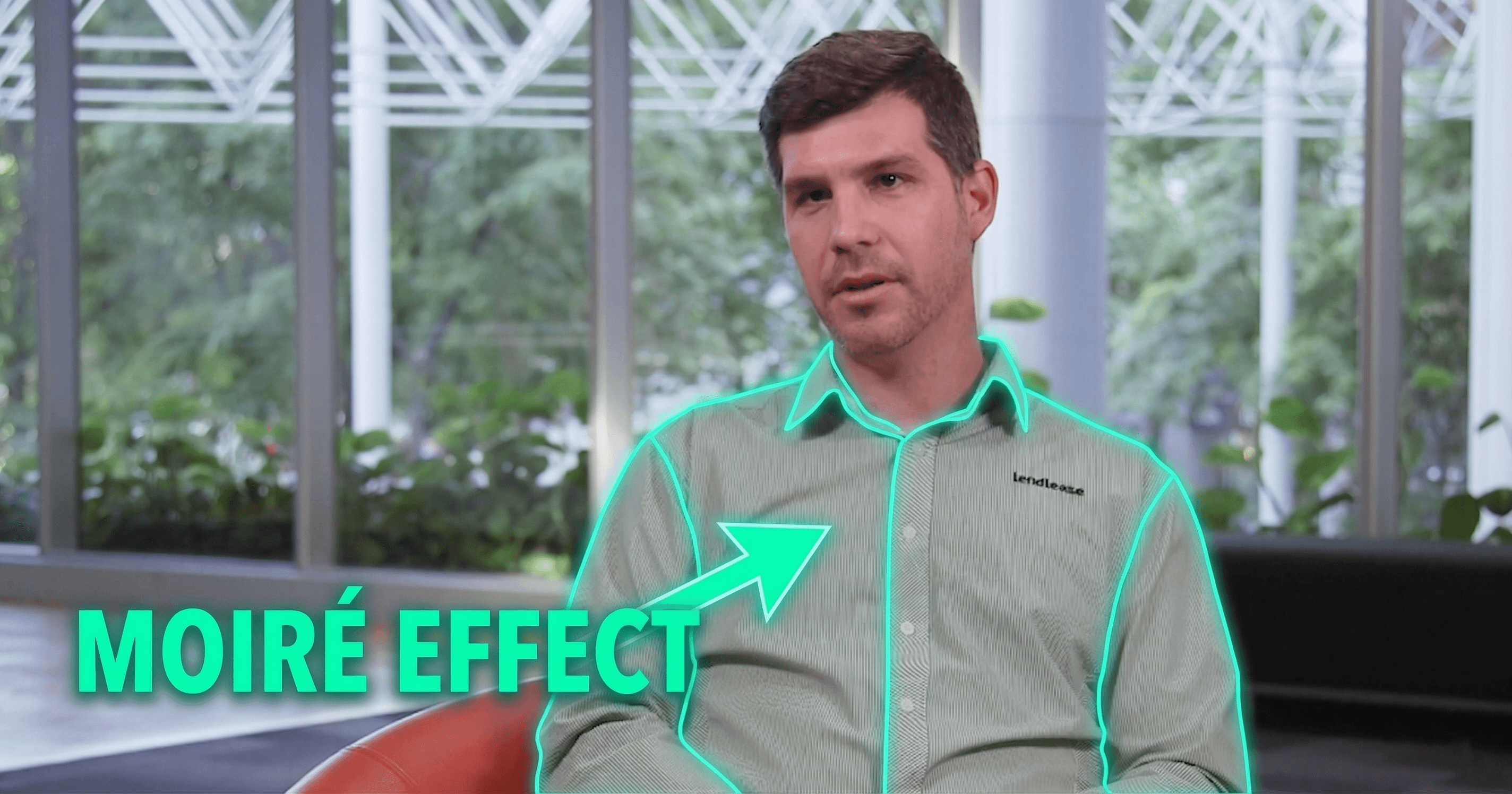
1. The Moiré Effect (The Shaky Shirt)
This is the most common and distracting error. Moiré occurs when a repetitive pattern (like a fine pinstripe shirt or a tightly checkered jacket) clashes with the pixel grid of the camera’s sensor. It creates a shimmering, moving wave pattern that draws the investor’s eye away from the CEO and onto their clothes. The solution is always preventative: a strict wardrobe protocol that bans fine patterns, or using a higher-resolution sensor with an optical low-pass filter to soften the signal before the crash occurs.
2. Dynamic Range Frequency Clash
In modern offices with LED screens, large glass windows, and fluorescent overhead lights, the camera is simultaneously fighting three different sources of light frequency and intensity. When these clash, you get every editor's nightmare, the flickering lights. We resolve this on shoot day by physically overriding the room’s ambient lights or using powerful, cinematic LEDs that dictate the room's master frequency, creating a consistent signal the sensor can lock onto.
3. 'Vocal Static' from Poor Microphones
You can tolerate a slightly fuzzy image, but you will never trust a voice that sounds like it is underwater. Poor-quality microphones or improper placement introduce environmental 'static'. The viewer's brain has to work harder to decode the words, which is energy they should be using to decode your strategy. We prioritise dual-redundant, broadcast-grade lavalier microphones to ensure the voice remains the dominant and purest signal in the mix.
4. The Jelly Effect (Rolling Shutter)
When I'm filming b-roll (like a quick pan across a facility or tracking a subject in motion), cheaper cameras can suffer from 'rolling shutter'. Because the sensor reads the image from top to bottom rather than all at once, fast movement can cause vertical lines (like door frames or machinery) to appear to lean or jiggle like jelly. To eliminate this and ensure the footage looks rock-solid, I shoot most on-site b-roll at a higher frame rate (like 50 or 100 frames per second). This higher temporal resolution, combined with a faster shutter speed, effectively freezes the distortion. When slowed down in the edit, it transforms chaotic movement into a smooth, high-authority cinematic sequence.
5. The Skin Tone Trap (White Balance)
Most cameras have an auto white balance feature that tries to guess the colour of the light. In an office with warm overhead lights and cool natural light from a window, the camera often gets it wrong. This results in skin tones that look sickly orange or unnaturally blue. To ensure a leader looks healthy and authoritative, we manually calibrate the white balance on set, locking in a natural, consistent colour temperature from the first frame to the last. It means that when the footage hits the edit, the colours are already accurate.
Summary: A Clean Signal
The common thread here is information friction. Our job is to strip away the technical static (the moiré, the flicker, the distortion) so the audience can receive your strategy with zero distractions. Precision behind the lens ensures authority on the screen.
5 Technical Traps:
What the Audience Sees
(and you can't unsee).
18 April 2025
Most people won’t know why a CEO looks unprofessional on camera. They just perceive it. In high-stakes capital market communications, that perception can dilute your authority.
These are things most people on set miss, but your audience subconsciously registers. Here is how we identify and eliminate five critical technical traps.…
1. The Moiré Effect (The Shaky Shirt)
This is the most common and distracting error. Moiré occurs when a repetitive pattern (like a fine pinstripe shirt or a tightly checkered jacket) clashes with the pixel grid of the camera’s sensor. It creates a shimmering, moving wave pattern that draws the investor’s eye away from the CEO and onto their clothes. The solution is always preventative: a strict wardrobe protocol that bans fine patterns, or using a higher-resolution sensor with an optical low-pass filter to soften the signal before the crash occurs.
2. Dynamic Range Frequency Clash
In modern offices with LED screens, large glass windows, and fluorescent overhead lights, the camera is simultaneously fighting three different sources of light frequency and intensity. When these clash, you get every editor's nightmare, the flickering lights. We resolve this on shoot day by physically overriding the room’s ambient lights or using powerful, cinematic LEDs that dictate the room's master frequency, creating a consistent signal the sensor can lock onto.
3. 'Vocal Static' from Poor Microphones
You can tolerate a slightly fuzzy image, but you will never trust a voice that sounds like it is underwater. Poor-quality microphones or improper placement introduce environmental 'static'. The viewer's brain has to work harder to decode the words, which is energy they should be using to decode your strategy. We prioritise dual-redundant, broadcast-grade lavalier microphones to ensure the voice remains the dominant and purest signal in the mix.
4. The Jelly Effect (Rolling Shutter)
When I'm filming b-roll (like a quick pan across a facility or tracking a subject in motion), cheaper cameras can suffer from 'rolling shutter'. Because the sensor reads the image from top to bottom rather than all at once, fast movement can cause vertical lines (like door frames or machinery) to appear to lean or jiggle like jelly. To eliminate this and ensure the footage looks rock-solid, I shoot most on-site b-roll at a higher frame rate (like 50 or 100 frames per second). This higher temporal resolution, combined with a faster shutter speed, effectively freezes the distortion. When slowed down in the edit, it transforms chaotic movement into a smooth, high-authority cinematic sequence.
5. The Skin Tone Trap (White Balance)
Most cameras have an auto white balance feature that tries to guess the colour of the light. In an office with warm overhead lights and cool natural light from a window, the camera often gets it wrong. This results in skin tones that look sickly orange or unnaturally blue. To ensure a leader looks healthy and authoritative, we manually calibrate the white balance on set, locking in a natural, consistent colour temperature from the first frame to the last. It means that when the footage hits the edit, the colours are already accurate.
Summary: A Clean Signal
The common thread here is information friction. Our job is to strip away the technical static (the moiré, the flicker, the distortion) so the audience can receive your strategy with zero distractions. Precision behind the lens ensures authority on the screen.
Want the strategic blueprint? This article is about the technical traps. If you need the actual framework for your next update, including my proven storytelling structures and investor-first messaging tips, download the Investor Video Playbook on the Insights page.
Want the strategic blueprint? This article is about the technical traps. If you need the actual framework for your next update, including my proven storytelling structures and investor-first messaging tips, download the Investor Video Playbook on the Insights page.

Written by Callum Koch - Director of Production
Foresight Media
Written by Callum Koch - Director of Production
Foresight Media